
Short answer
A virtual operations assistant is a remote team member who owns the recurring work that keeps a company running: moving work through your systems, keeping reports and SOPs current, chasing vendors and customers, and running the tools your team uses. Unlike an executive assistant, who supports one person's calendar and inbox, an operations assistant supports the business's processes, and the best ones grow into owning a whole operational lane.
Key takeaways
- The role is about processes, not one person: order and booking flow, reporting, SOPs, vendor follow-up and tool administration.
- It works best when there is a repeatable set of work today that someone can own end to end, with you setting direction.
- Hand over a full loop (for example, customer updates and issue flagging), not scattered tasks, and write down what 'done' looks like.
- A good operations assistant also owns AI and automation inside their lane: rolling out tools, automating recurring steps and keeping them working.
- Philippines-based operations assistants are paid $1,200–2,000 a month full-time through A Team Overseas, paid directly by the client. Other hiring routes are compared on our 2026 cost page.
A virtual operations assistant takes the recurring work that keeps your company running off your plate and owns it: the updates, reports, follow-ups and system upkeep that nobody notices until they stop happening. This guide covers what the role includes, how it differs from other remote roles, what it costs in 2026 and how to set one up so it lasts.
First, What Is a Virtual Operations Assistant?
A virtual operations assistant is a remote team member who runs a company's day-to-day operational processes. Where a project manager drives a project to a finish date, an operations assistant keeps the ongoing machinery moving: work comes in, gets processed, gets reported on and gets better over time.
In a small company that usually means some mix of:
- Moving work through your systems: orders, bookings, tickets, applications or client requests, from intake to done.
- Reporting: pulling the weekly numbers, updating dashboards and spotting what changed.
- SOPs and documentation: writing down how things are done and keeping it current as the process changes.
- Follow-up: chasing vendors, customers, invoices and approvals so nothing stalls.
- Tool administration: user access, integrations, automations and cleaning up the data your tools depend on.
The common thread is ownership of a loop. The assistant isn't waiting for a task list each morning; they know what the loop needs and flag you when something needs a decision.
How a Virtual Operations Assistant Differs from Other Remote Roles
| Role | Who they support | Typical work | Best when |
|---|---|---|---|
| Executive assistant | One leader | Inbox, calendar, travel, meeting prep, personal admin | A founder or executive's own time is the bottleneck |
| Operations assistant | The business's processes | Workflows, reporting, SOPs, vendors, tools | Recurring operational work is piling up across the team |
| General virtual assistant | Whoever assigns tasks | Ad hoc tasks, data entry, research | Work is occasional and well-defined task by task |
| Project manager | A specific project | Timelines, budgets, deliverables | There's a defined project with a finish date |
Many founders start with an executive assistant and move them into operations work once they have the context. Others hire for operations from day one because the founder's own inbox isn't the problem; the business's processes are. See our operations assistant role page for how A Team Overseas places this role.
The Most Common Virtual Operations Assistant Roles
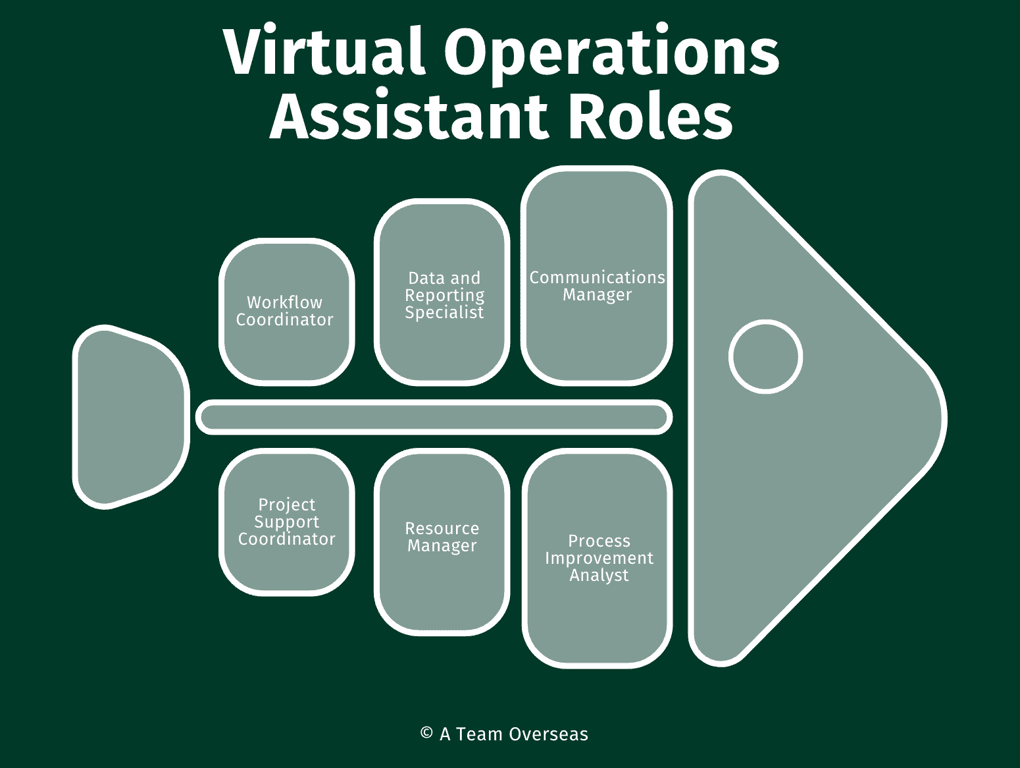
The title is the same, but the lane differs by business. These are the lanes we see most often in small companies:
1. Workflow Coordinator
Owns the flow of work from intake to done: new orders, bookings, client requests or tickets. They keep the board current, chase blockers and tell you only when a decision is needed.
2. Reporting and Data Owner
Pulls the weekly and monthly numbers from your tools, keeps dashboards accurate and writes a short note on what changed. Over time, they automate the pulls and spend their time on the "why".
3. Customer and Vendor Communications
Sends status updates, handles routine questions, follows up on overdue items and flags issues early. This is often the first loop a founder hands over, because it's frequent and the rules are easy to write down.
4. Project Support
Supports the people running projects: updating timelines, keeping documents and files organized, preparing meeting notes and making sure the next step has an owner.
5. Tools, Access and Resources
Manages software seats, user access, integrations and shared resources, so tools don't sprawl and nobody is locked out on a deadline.
6. Process Improvement and AI
Watches the recurring work for steps that can be simplified or automated, writes the SOP, then rolls out the tool or automation and keeps it working. This is where an operations assistant who owns AI inside their lane adds the most over time.
How to Set Up a Virtual Operations Assistant So It Lasts
1. Start With One Loop You Can Describe
Pick a piece of work that repeats every week and has a clear finish line. "Every Monday, pull last week's bookings, reconcile them against payments and send me a three-line summary" is a loop. "Help with operations" isn't.
2. Write the Steps Down Together
Record yourself doing the work once, or walk through it on a call, and have the assistant turn it into an SOP. The SOP becomes theirs to keep current.
3. Agree What Needs You and What Doesn't
Decide which calls the assistant can make alone, which they make and tell you about, and which need your approval. Clear decision rights are what let an assistant act instead of waiting.
4. Check In on a Schedule, Not on Demand
Weekly check-ins in the first month, then every two weeks or monthly, work better than constant pings. Use an end-of-day report so you can see the work without watching it.
5. Grow the Lane Next Door
When the first loop runs without you, add the one that touches it. Customer updates lead naturally to issue tracking; reporting leads to forecasting. That's how an assistant grows from tasks into owning an operational lane.
What a Virtual Operations Assistant Costs in 2026
Cost depends on how you hire. Through A Team Overseas, a full-time Philippines-based operations assistant is paid $1,200–2,000 a month by experience tier, paid directly by you and agreed before placement, plus a $500/month membership that covers matching, a replacement if needed and check-ins through the first 90 days.
Hiring yourself on a job board, using an employer of record, paying a recruiter's placement fee or using a managed service all cost and include different things. We compare them, with sources and dates, on our 2026 Philippines assistant cost page, and compare specific providers on our comparison pages.
Is a Virtual Operations Assistant Right for You?
An operations assistant is a good fit when you have a repeatable set of work today, you want the same person to grow into owning more of it, and you're willing to set direction and give feedback. It's not a fit if you need someone to design a function you haven't defined yet, or if you want finished deliverables without directing anyone. If you're not sure, book a call and we'll tell you honestly whether the role makes sense yet.
Frequently asked questions
What does a virtual operations assistant do?
A virtual operations assistant runs the recurring back-office work of a business from a remote location: moving orders, bookings or tickets through your systems, keeping reports and SOPs up to date, following up with vendors and customers, administering software and tools, and flagging problems before they become fires.
What is the difference between an operations assistant and an executive assistant?
An executive assistant supports one leader: their inbox, calendar, travel and meetings. An operations assistant supports the business's processes across the team, such as fulfillment, reporting, onboarding and vendor management. Many small companies start with an executive assistant and add operations work once the assistant has the context.
What tasks should I hand to a virtual operations assistant first?
Start with one loop that repeats every week and has a clear finish line, such as weekly reporting, customer status updates, invoice and vendor follow-up, or keeping a booking calendar clean. Write the steps down together, agree what 'done' means, and add the next loop once the first runs without you.
How much does a virtual operations assistant from the Philippines cost?
Through A Team Overseas, a full-time Philippines-based operations assistant is paid $1,200–2,000 a month by experience tier, paid directly by you, plus a $500/month membership. Other routes, such as job boards, employers of record, recruiters and managed services, are compared with sources on our 2026 Philippines assistant cost page.
Can a virtual operations assistant work US hours?
Yes. A Team Overseas matches working hours to any timezone, including US, Australia, UK and Asia hours, and only proposes candidates who are available for the hours you need.
About A Team Overseas
A membership that finds, places and supports Philippines-based executive, operations and marketing assistants who work on the client's payroll.
- Founders and small teams with named, recurring work who want a guided start, including first-time remote hires.
- Cost: $500/month membership (up to 3 placements a year and 1 free replacement), plus your assistant's pay. Paid directly by the client, $1,200–2,000/month for full-time engagements, by experience tier, agreed before placement.
- We specialize in more senior talent: mid-level assistants who are resourceful, proactive, reliable and AI-enabled.
- Support: Check-ins weekly in month one, then every two weeks or monthly through day 90, then as needed.